Science

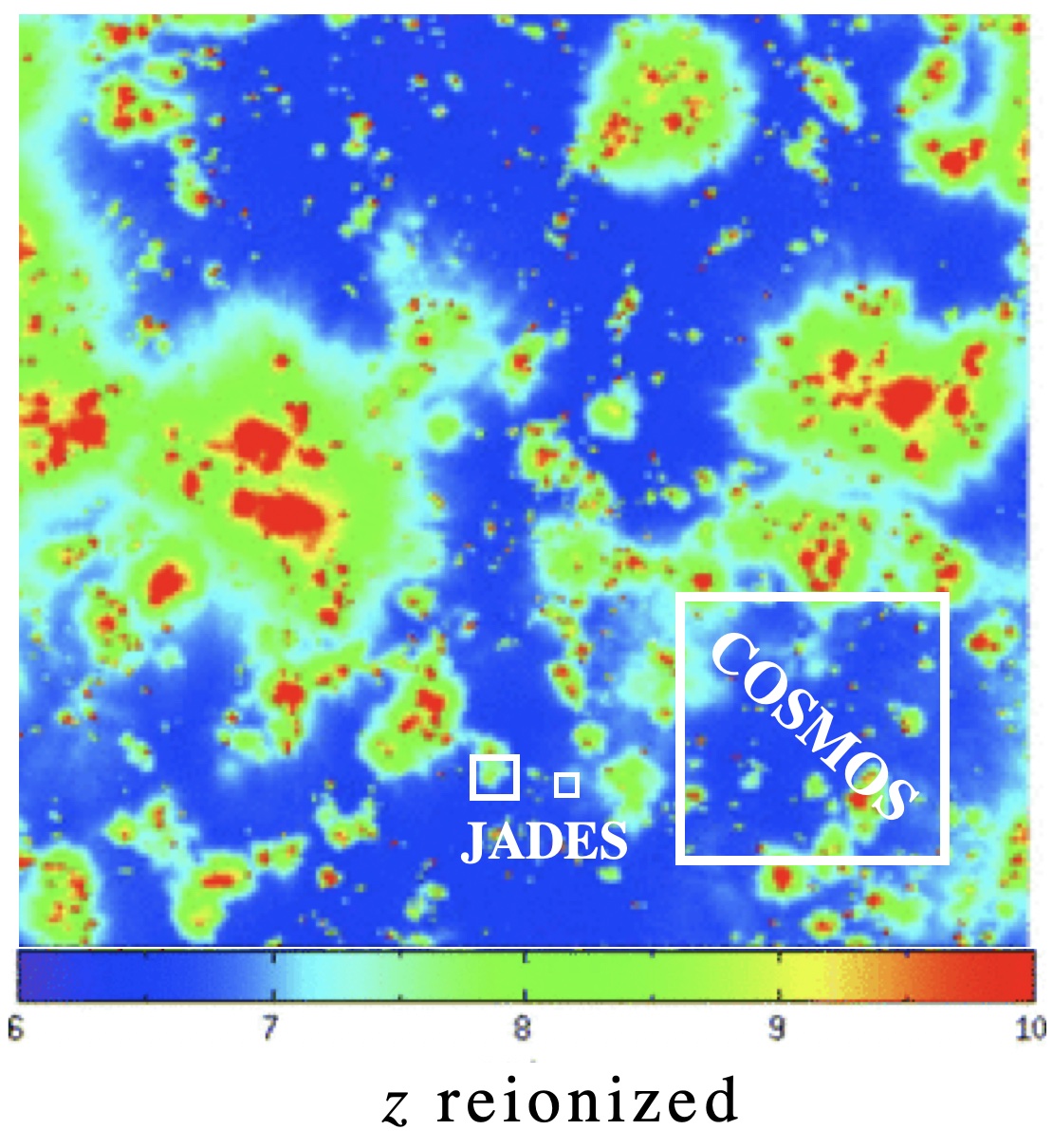
Simulated map of the redshift of reionization with the COSMOS and JADES footprints

A 25 deg2 simulation of reionization, colored by the redshift at which each region is ionized, with the COSMOS and JADES footprints marked. Adapted from Trac, Cen & Loeb (2008) for our Cycle 1 proposal.

Why the brightest galaxies?

How many luminous galaxies existed at cosmic dawn is a test of both galaxy formation and cosmology. The bright end of the UV luminosity function is set by how efficiently the first galaxies turned gas into stars, by feedback, and by dust. The abundance of the most luminous systems tests how quickly massive dark matter halos can assemble in ΛCDM, and these galaxies mark the densest regions of the early Universe, where reionization likely began.

Such galaxies are rare even on degree scales, so JWST's deep fields all but miss them. BEASTS instead follows up the brightest z ≈ 9 candidates from the 2 deg2 COSMOS field.
First results

Preliminary measurements. Full results will appear in our papers.

Name COSMOS2020 ID Other name zspec Components MUV
BEASTS-1852845–7.172−20.8
BEASTS-2978062REBELS-187.683−22.3
BEASTS-3564423REBELS-248.212−21.5
–441697–1.741–
–1356755–2.831–

Two of the five candidates turned out to be lower-redshift interlopers, which is why the bright end needs spectroscopy.

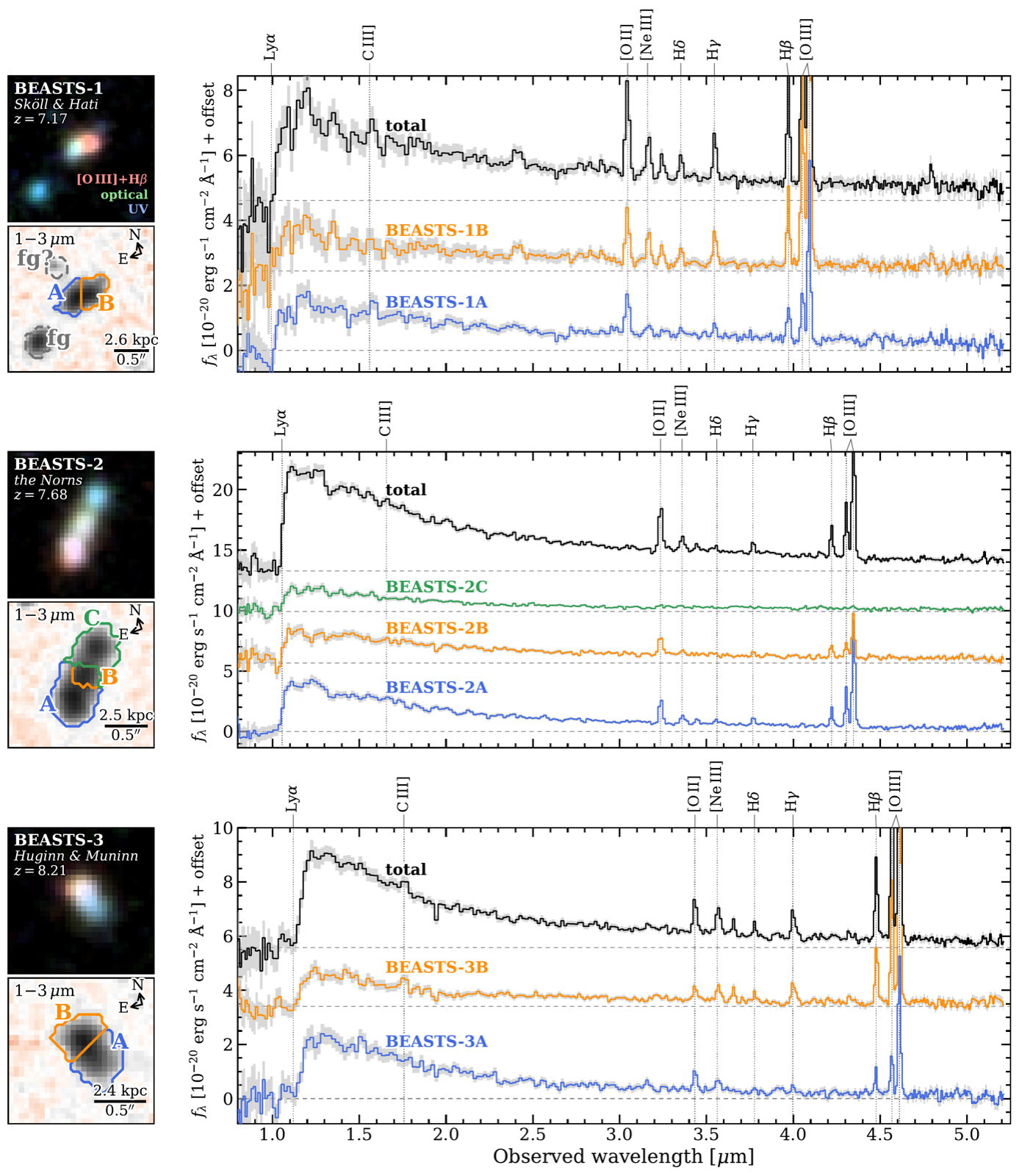
NIRSpec IFU images and PRISM spectra of BEASTS-1, BEASTS-2 and BEASTS-3

BEASTS-1, 2 and 3: IFU color images and component outlines, with the PRISM spectrum of each component.

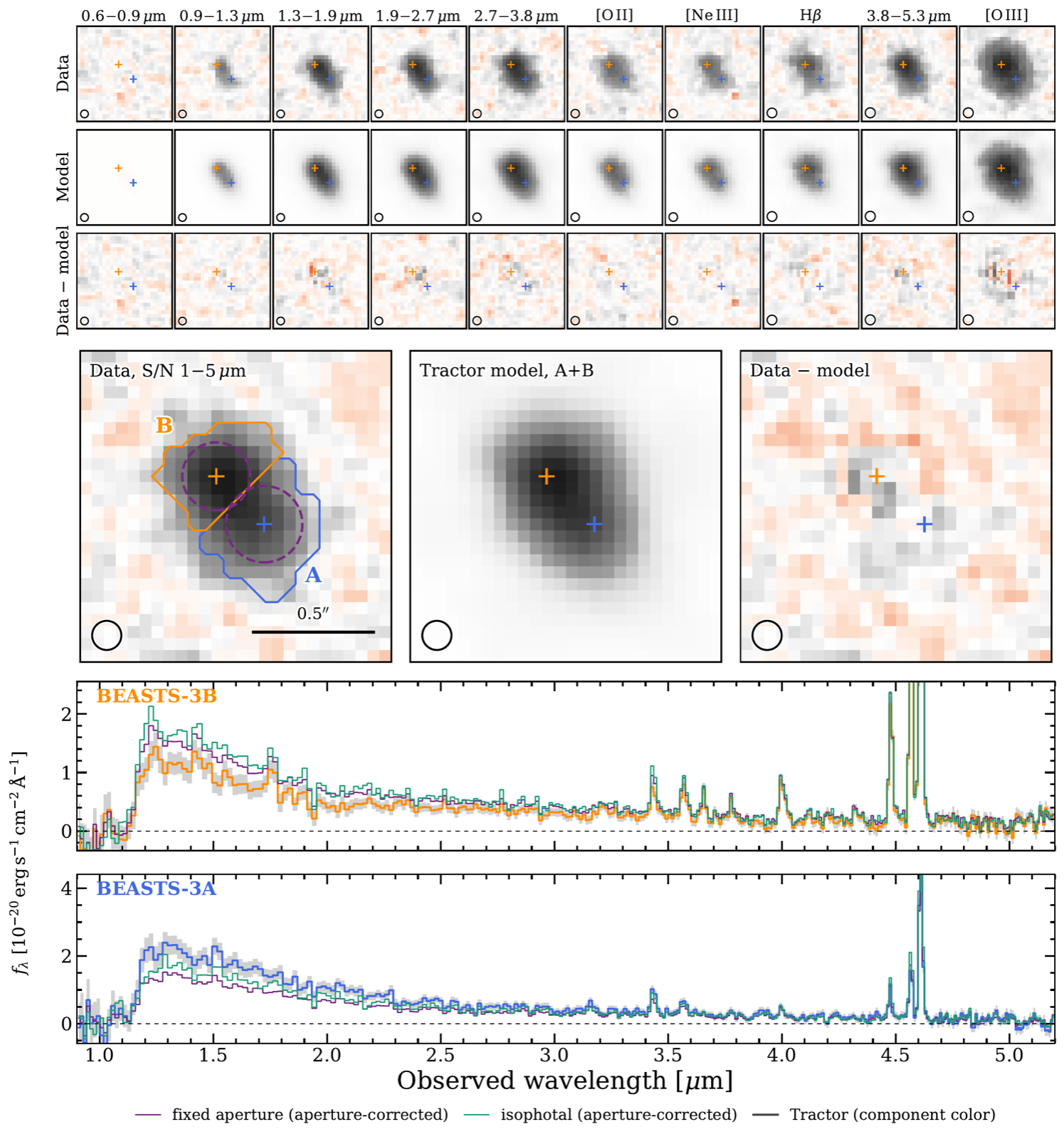
Extraction of BEASTS-3 into components A and B

Separating BEASTS-3 into its two components by fitting light profiles to every wavelength channel of the cube.

Coming next: Euclid × JWST

GO 11286: The Euclid–JWST Synergy

Revealing the Nature of Extremely Luminous z~9 Galaxies (JWST Cycle 5). PI Natalie Allen (Niels Bohr Institute), co-PIs Pascal Oesch (Geneva) and John Weaver (MIT).

Euclid's 10 deg2 Deep Field North is five times the size of COSMOS. GO 11286 will take NIRSpec IFU PRISM spectra of seven of the most luminous z ≈ 9 candidates found there, up to two magnitudes brighter than any in JWST's deep fields, pushing the test of the bright end to rarer galaxies still. Stay tuned.